Luxury Cruise Suite Options: A 2026 Definitive Reference for High-Net-Worth Travelers
The luxury cruise sector of 2026 has fundamentally diverged from the “mass-premium” models of the past decade. For the modern high-net-worth traveler, the definition of a suite has migrated from mere square footage to a sophisticated ecosystem of private governance, restorative technology, and “invisible” service. In an era where the hardware of cruising—ship size, engine efficiency, and hull design—has reached a plateau of excellence, the competitive differentiator has become the suite’s ability to function as a sovereign residence within a floating community.
To evaluate luxury cruise suite options is to engage with a complex hierarchy of space and service. The market in 2026 is characterized by “duplex” architectures, four-story glass-enclosed funnel suites, and expedition vessels that combine ice-breaking capabilities with the refined interiors of a Parisian hôtel particulier. As the industry welcomes new entrants from land-based luxury icons like Four Seasons and Ritz-Carlton, the criteria for “best-in-class” have shifted toward personalized micro-environments—suites that adapt their lighting, air quality, and nutritional offerings to the specific biometric needs of the guest.
This article provides a rigorous, systemic deconstruction of the premium cruise suite landscape. We will explore the historical evolution from class-based ocean liners to integrated “ship-within-a-ship” enclaves, analyze the mental models used by elite travelers to judge value, and examine the failure modes that can compromise even the most palatial accommodations. By treating the luxury suite as a managed asset rather than a vacation room, we provide the depth required to navigate the complexities of 2026’s maritime hospitality market.
Understanding “luxury cruise suite options”
The phrase luxury cruise suite options is frequently used as a marketing catch-all, but from a professional editorial standpoint, it refers to a specific set of measurable criteria. In 2026, a “suite” is no longer defined simply by having a separate living area. It is defined by its operational autonomy.
The Problem of “Pseudo-Luxury”
One of the primary misunderstandings in the current market is the conflation of “large staterooms” with “suites.” Many premium cruise lines offer cabins with high-end finishes that they categorize as suites, but these lack the fundamental service architecture required for true luxury. When you compare luxury cruise suite options, you must look for the “Buttress” of service—the presence of a dedicated butler, a private concierge, and exclusive access to dining and recreation zones that are geographically and socially isolated from the rest of the ship.
The Shift Toward Residential Sovereignty
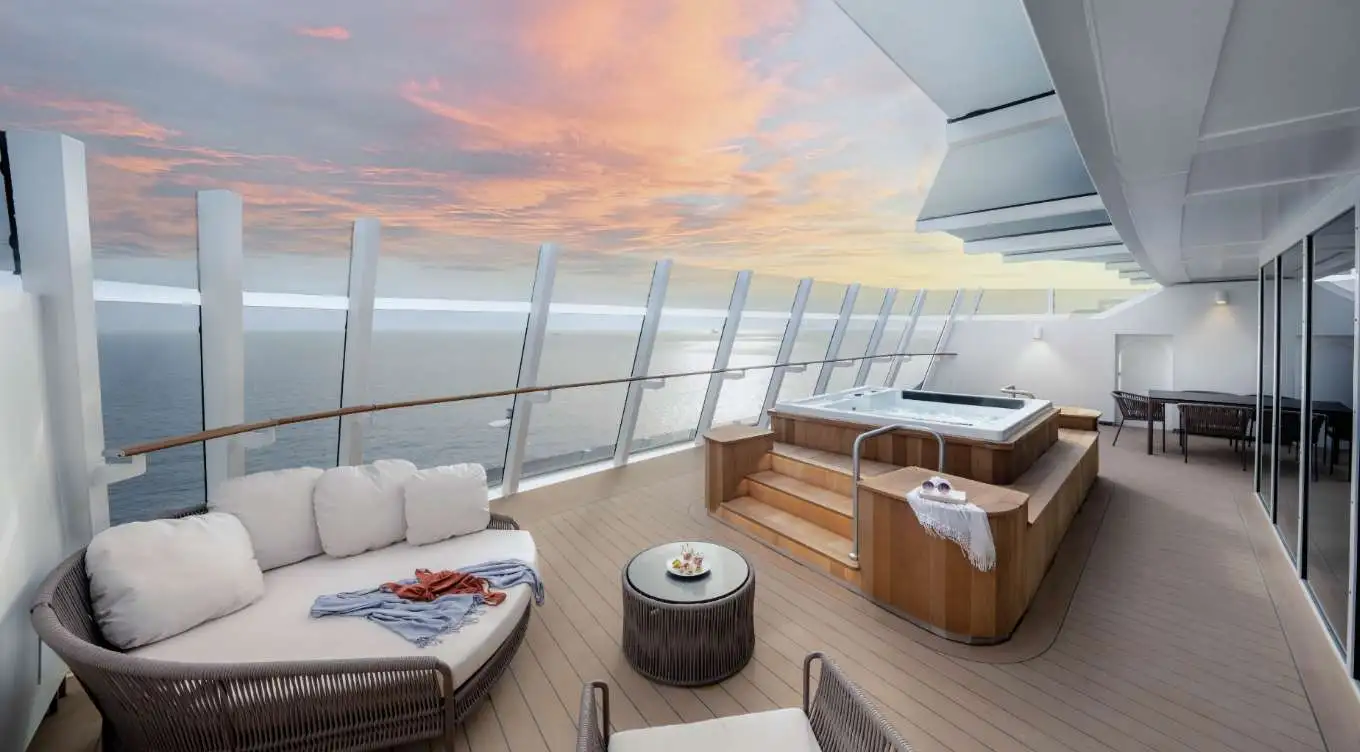
The most authoritative suite options in 2026 are those that operate as a “sovereign residence.” This means the suite is not just a place to sleep, but a place to govern one’s life. This includes in-suite spa facilities (saunas, steam rooms), full-scale kitchens with separate staff entrances for private dining, and “Window Walls” that use advanced glass technology to offer unobstructed 270-degree views without compromising thermal or acoustic integrity.
The Role of Technological Invisibility
In 2026, luxury is increasingly measured by the absence of tech friction. The best suites feature “invisible” technology: air filtration systems that detect and neutralize allergens in real-time, circadian lighting that automatically adjusts to mitigate the impact of changing time zones, and “smart” acoustic dampening that achieves a “library-quiet” decibel level even during heavy seas or port operations.
Deep Contextual Background: The Evolution of Maritime Grandeur
The history of the luxury suite is a trajectory from the rigid class divisions of the 19th-century ocean liner to the fluid, choice-driven enclaves of 2026. In the era of the Titanic or the Queen Mary, “First Class” was a social designation. Suites were opulent but lacked the technical complexity we see today. They were designed to emulate the grand hotels of London and Paris, focusing on marble, heavy fabrics, and silver service.
The mid-20th century “Golden Age” of cruising (1950s–1970s) saw a pivot as air travel replaced ships for transportation. Cruising reinvented itself as a leisure activity. Suites became “resort-like,” introducing the first private balconies and more casual layouts. However, it wasn’t until the 1990s and early 2000s that the “ship-within-a-ship” concept (e.g., The Haven by Norwegian or MSC Yacht Club) began to democratize access to exclusivity on large vessels.
By 2026, we have entered the “Hyper-Intimate Estate” era. This phase is characterized by a desire for total autonomy. Travelers no longer want a “shared luxury” experience; they want a bespoke ecosystem. This has led to the emergence of “Funnel Suites”—sprawling, multi-level residences housed within a ship’s iconic structure—and the revival of the “Guild of Professional English Butlers” standard, where a single point of contact manages every touchpoint from the pier to the pillow.
Conceptual Frameworks and Mental Models
To systematically evaluate luxury cruise suite options, travelers and advisors use several mental models that look beyond the brochure photos.
1. The Ratio of Isolation to Integration
This model measures how successfully a suite balances the need for privacy with the desire to enjoy the ship’s broader amenities. The highest-tier suites offer “curated access,” allowing the guest to move from their private terrace to a Michelin-starred restaurant via private elevators, ensuring they never encounter a “crowd.”
2. The Thermal and Acoustic Envelope
Luxury at sea is fundamentally the management of the environment. This framework evaluates a suite by its ability to maintain a consistent microclimate and silence. Does the glass prevent solar gain in the Caribbean? Does the soundproofing block the vibration of the thrusters? A suite that fails this test is merely a “premium cabin.”
3. The “Silent Service” Factor
This framework measures the ratio of staff presence to guest awareness. The highest level of luxury is achieved when a need is met before it is expressed. If a guest returns from an excursion and finds their favorite drink chilled and their laundry perfectly pressed without having seen a member of the crew, the “Silent Service” has succeeded.
Key Categories and Strategic Trade-offs
When you evaluate luxury cruise suite options, you are choosing between different operational philosophies. Each category offers a specific value proposition with inherent trade-offs.
| Category | Typical Line | Key Service | Strategic Trade-off |
| The “Ship-within-a-Ship” | MSC (Yacht Club) | Private Concierge | High exclusivity vs. being on a 5,000-passenger vessel. |
| The Ultra-Luxury Boutique | Silversea / Seabourn | Universal Butler | Total intimacy vs. fewer on-board dining/activity options. |
| The Expedition Residence | Ponant / Scenic | Specialized Guides | Remote access vs. potentially smaller suite footprint. |
| The Yacht Collection | Ritz-Carlton / Four Seasons | Resort-style Service | High personalized attention vs. less “traditional” cruise vibe. |
| The All-Inclusive Palace | Regent Seven Seas | Pre-paid Excursions | Maximum ease of planning vs. high upfront cost. |
| The Modernist Duplex | Explora / Oceania | Lifestyle Branding | Contemporary design vs. less “old-world” formality. |
Decision Logic: Intimacy vs. Variety
The choice often hinges on the “unit of social desire.” For travelers seeking a “social hub” with multiple theaters and pools, the “Ship-within-a-Ship” enclave is superior. For those seeking “intellectual luxury”—intensive cultural lectures and small-group dinners—the Ultra-Luxury Boutique or Expedition Residence is the more strategic choice.
Detailed Real-World Scenarios
Scenario 1: The “Invisible” Service Failure
A guest in a $15,000-per-night suite on a Mediterranean cruise returns from a hot day in Ephesus. They find that the suite’s AC has malfunctioned and the butler is busy with another guest.
-
The High-End Response: A professionally managed suite has a 24/7 dedicated technician and “redundant” suites held in reserve for immediate relocation.
-
Failure Mode: A “mass-premium” line might offer a credit for a future cruise, which does nothing to resolve the immediate physiological discomfort of a hot room.
Scenario 2: The Multi-Generational Transition
A family of eight, spanning three generations, books a Grand Loft Suite.
-
The Technical Requirement: The suite must have “contiguous privacy”—connecting rooms that allow for shared meals but independent rest.
-
Strategic Success: The best suites in 2026 feature dining tables that seat 10+, private in-suite elevators, and “Kids’ Zones” that are acoustically isolated from the adult living areas.
Scenario 3: The Nutritional Sourcing Logistics
A guest with severe dietary restrictions (e.g., AIP diet) books a world cruise.
-
The Operational Challenge: The butler and chef must source 100% compliant ingredients across 40 different ports of call.
-
Decision Point: Does the suite have its own dedicated pantry and “Chef-on-Call” service, or is the guest dependent on the main galley’s schedule?
Planning, Cost, and Resource Dynamics
The financial structure of luxury cruise suite options is significantly more complex than a standard booking. The nightly rate is often only the “base” of the expenditure.
Direct and Indirect Costs
-
Fare Inclusions: True luxury suites (e.g., Regent) include flights, transfers, shore excursions, and even hotel stays.
-
Ancillary Spend: On “mass-premium” lines, the suite rate may not cover high-end wines, specialized spa treatments, or private excursions, which can add 20–30% to the total cost.
-
Opportunity Cost: The value of “priority everything.” For a guest whose time is valued at $10,000/hour, bypassing a 45-minute embarkation queue or a 30-minute wait for a table is a significant return on investment.
Estimated Pricing Spectrum (2026 Projections)
| Suite Category | Typical Weekly Rate (USD) | Staffing Level | Primary Value |
| Grand/Owner’s Suite | $40,000 – $150,000+ | Dedicated Butler | Total privacy & total customization. |
| Master/Penthouse Suite | $20,000 – $35,000 | Shared Butler | Large footprint & priority access. |
| Veranda/Horizon Suite | $8,000 – $15,000 | Suite Steward | High-end amenities in a smaller space. |
Tools, Strategies, and Support Systems
To effectively evaluate luxury cruise suite options, travelers and their advisors utilize a specific toolkit:
-
Digital “Walk-Through” Tools: In 2026, the best lines provide 1:1 VR walkthroughs of specific suite numbers (e.g., Suite 1002 vs. 1004) to show exact views and furniture placement.
-
Acoustic & Vibration Mapping: High-end advisors use proprietary “heat maps” of ships to identify suites that are most susceptible to engine vibration or public deck noise.
-
Pre-Arrival Preference Surveys: A critical strategy is the “72-Hour Consultation” where the guest speaks directly with their future butler to discuss allergies, pillow types, and minibar stocking.
-
Loyalty Status “Status Matching”: Many lines (e.g., Explora Journeys) now offer to match the status of high-end hotel programs (Marriott Bonvoy, Hilton Honors), providing immediate suite upgrades.
Risk Landscape and Failure Modes
The primary risks in luxury suite stays are “compounding.” A minor mechanical failure in a remote location can trigger a cascading loss of utility.
1. The “Neighbor Effect”
Because suites are often grouped on high decks, the risk of “public deck noise” (e.g., chairs scraping on the pool deck above) is high. A $50,000 suite with a scraping sound every morning at 6:00 AM is a failure of the “luxury” designation.
2. Staff Continuity Risk
A suite stay is only as good as the butler. If the primary butler falls ill, the “service engine” stops. The best lines maintain a “service redundancy” model where an assistant butler is equally briefed on the guest’s preferences.
3. Regulatory and Environmental Volatility
In 2026, some ports are restricting large ships. A traveler in a top suite might find their “exclusive port call” replaced by a “sea day” due to sudden local environmental mandates. The best suite options are on smaller “yacht-style” vessels that bypass these restrictions.
Governance, Maintenance, and Long-Term Adaptation
How does a suite maintain its “five-star” status year after year? It requires a rigorous governance model that treats the suite as a high-utilization asset.
The “White Glove” Audit Cycle
A suite that is not professionally audited every 14 days will quickly degrade. This audit should cover:
-
Olfactory Analysis: Ensuring no “marine odors” or “carpet stale” smells.
-
Mechanical Stress Tests: Running all AC units and whirlpool tubs at maximum capacity.
-
Digital Sanitation: Verifying all smart devices are updated and previous guest data is purged.
Layered Maintenance Checklist
-
Daily: Linens checked for thread-wear; balcony glass cleaned of salt spray.
-
Weekly: Deep-clean of HVAC filters to ensure air purity.
-
Quarterly: Assessment of furniture ergonomics and “soft goods” (curtains, upholstery) for UV damage.
Measurement, Tracking, and Evaluation
Post-stay evaluation is the only way to ensure future quality. The “Leading” vs. “Lagging” indicator model is particularly useful here.
-
Leading Indicator: The speed and detail of the pre-arrival outreach (indicates management’s level of preparation).
-
Lagging Indicator: The “Re-book Rate” for the specific suite number (the ultimate signal of quality).
-
Qualitative Signal: The “Invisible Hand” effect—did the butler solve a problem before the guest even noticed it existed?
Documentation Examples
-
Preference Continuity Logs: Ensuring that if a guest stays on Ship A in January, their preferences are already at Ship B in June.
-
Service SLA Logs: Tracking the response time for in-suite dining or maintenance requests (Target: < 5 minutes for acknowledgement).
Common Misconceptions and Oversimplifications
-
Myth: All suites have a butler.
-
Correction: Many “Junior Suites” are merely larger rooms with no dedicated service staff.
-
-
Myth: The biggest suite is always the best.
-
Correction: A mid-ship Master Suite often has less motion than a massive Forward Owner’s Suite.
-
-
Myth: You don’t need travel insurance for a luxury suite.
-
Correction: The “Cancel For Any Reason” (CFAR) policy is mandatory for high-stakes bookings where the loss can exceed $50,000.
-
-
Myth: Room service is the same as in-suite dining.
-
Correction: True in-suite dining is served course-by-course, with table linens and a private waiter/butler.
-
-
Myth: All luxury lines are “all-inclusive.”
-
Correction: Many still charge for premium spirits, specialized excursions, and spa treatments.
-
Conclusion
The evolution of luxury cruise suite options reflects a broader cultural desire for meaningful connection with the sea, mediated by the highest standards of human comfort. These accommodations are essentially high-performance micro-environments disguised as opulent retreats. To successfully navigate this market—whether as an investor, operator, or guest—requires an appreciation for the hidden complexities of maritime logistics and a respect for the environmental constraints that define the high-altitude experience at sea. The future of the sector lies in its ability to adapt to a changing climate while maintaining the “timeless” sense of sanctuary that has drawn people to the ocean for centuries.